


 Back
Back- A brief history of St Helens Town
- Town Honours
- The First St Helens Town 1901-1928
- Cashbook in the Attic 1912-13
- St Helens Town - The Early Years
- Unearthing Town’s History
- Earliest St Helens Town photograph
- Town’s demise and reformation
- FA Vase victory in 1987
- Town Managers 1946 - Present
- A summer of Managerial Mayhem
- Town accounts from 1960s
- A History of Hoghton Road
- Hoghton Road Memories
- Town in the Liverpool County Combination
- Town in the Lancashire League
- Remembering Bert (1923-2013)
- A meeting with Bert Trautmann
- Mike Critchley speaks with Bert (2009)
- When Town met Man City
- A case of mistaken identity
- Not just any old scarf!
- Town in the Lancashire Cup
- Town in the Lancashire Junior Cup
- A brief history of St Helens Town
- Town Honours
- The First St Helens Town 1901-1928
- Cashbook in the Attic 1912-13
- St Helens Town - The Early Years
- Unearthing Town’s History
- Earliest St Helens Town photograph
- Town’s demise and reformation
- FA Vase victory in 1987
- Town Managers 1946 - Present
- A summer of Managerial Mayhem
- Town accounts from 1960s
- A History of Hoghton Road
- Hoghton Road Memories
- Town in the Liverpool County Combination
- Town in the Lancashire League
- Remembering Bert (1923-2013)
- A meeting with Bert Trautmann
- Mike Critchley speaks with Bert (2009)
- When Town met Man City
- A case of mistaken identity
- Not just any old scarf!
- Town in the Lancashire Cup
- Town in the Lancashire Junior Cup

3. The First St Helens Town 1901-1928
The First St. Helens Town 1901-1928
The current St. Helens Town Football Club is the second to bear the name. The first was formed in 1901, initially to rival the St. Helens Recreation club, which had only a few years earlier changed from rugby to football, under the patronage of the glass company, Pilkington Brothers.
The first meeting between the clubs took place before a crowd of over 5000 at Pilkingtons ground at City Road in February 1902 and resulted in a 2-2 draw. Based at the Primrose Ground in Park Road (subsequently a dog track behind the Primrose Vaults and now the site of Mulcrow Close), Town entered the Lancashire League Second Division in 1901-02, alongside Barrow, Workington, Haydock, Earlestown, Prescot and Chorley. Promotion was attained in 1904 and the following seasons fixtures in the Lancashire Combination First Division included the Reserve sides of Everton, Liverpool, Manchester City, Manchester United, Bolton, Bury and Preston North End. Although relegated later that season, Town bounced back to their former status in 1909 and, in between times, helped out the Recs, sharing their Park Road facilities whilst the City Road ground was re-built.
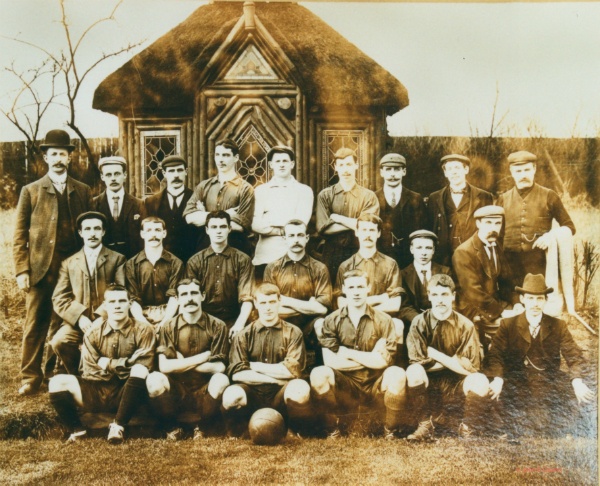
Earliest known photograph of St Helens Town circa 1901
St. Helens Town had ambitions to join the Football League and an application was made to join the new Third Division 1911, but this was unsuccessful. The senior clubs reserve sides set up the Central League in 1912/13 and Town became one of the leading lights in the revamped Lancashire Combination. At the end of that campaign, Recs. resigned and reverted to the handling code, joining the Northern Union (later the Rugby League) as a professional club, rivalling the Saints for success throughout the 1920s. This all-consuming local rivalry was one of the reasons for the failure of St. Helens Town and the club disbanded in the late 1920's. It was to take a further 20 plus years and another World War to revive interest in the association game, by which stage St. Helens Recs. had themselves thrown in the towel, having nearly brought about the bankruptcy of Saints during the depression of the 1930s.
Famous players for the first Town club included Oliver Ellaby, father of Alf, who went on to great deeds with Saints and Wigan, Jack Bamber (Liverpool) and Albert Fairclough (Manchester City, Bristol City and Derby County).
The programme for the Chester v St. Helens Town game in the Lancashire Combination on 13th September 1913 referred to the reverse fixture the previous week, which Town won 2-1. The editor said: The St. Helens ground is not one of the best, the surface being very uneven and against accurate footwork. St. Helens Town have a very strong side and, if their Saturday's form is kept up, other teams will go the same way home from there. For the record, Town were represented by: Talbott, Hall, Kelly, Platt, Hosker, Hunter, Ryder, Kelly, Jones, Benyon and Barton.